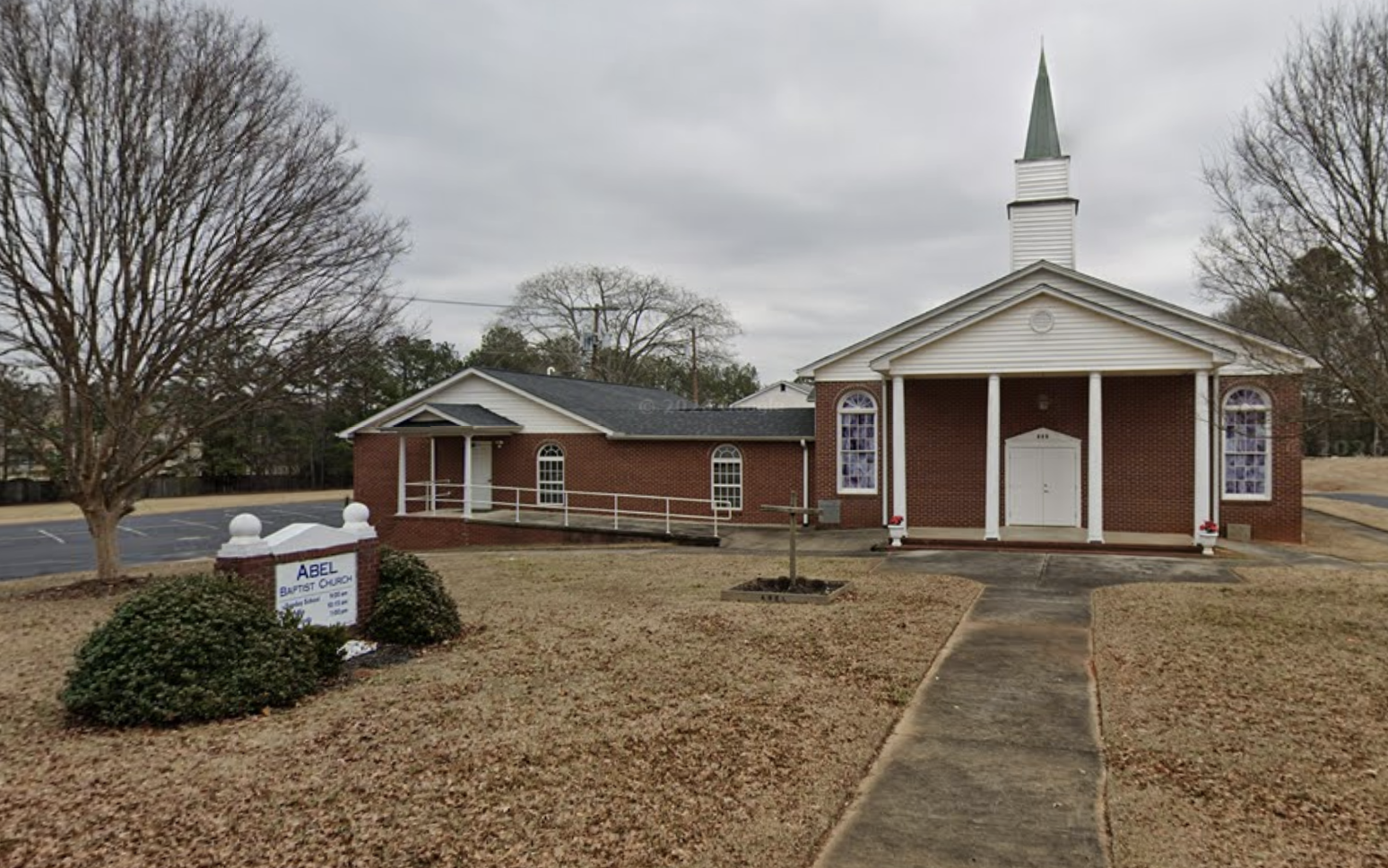
About Abel
Founded in 1868. Abel Baptist Church, was one of the earliest black churches in the area founded after the Civil War and freedom. It was one of sixteen churches which met in Anderson during August 1868 to form the Rocky River Baptist Association. It withdrew in 1879 to help form the Seneca River Missionary Baptist Association. In its early years the church was also called Labelle or Label in newspaper and association records.
The cemetery is divided into three sections, roughly according to chronological periods. Cemetery #1 was used from approximately 1870 until the 1920s. Cemetery #2 was used from the 1920s until the 1970s (with some later burials), and Cemetery #3 beginning just before 1960. Generally, plots were allocated for individuals rather than families, so burials followed a rough sequential order. Single grave plots were free for members of Abel, and later for members of its offspring church, Goldenview Baptist Church, Clemson, SC.
The persons in the cemetery who were born earliest in the 19th century are Thomas Fruster (1815), his wife Fannie Fruster (1832), Lucinda Whitner (1831), and Ransom R. Trimmier (1832), the person in the cemetery to live the longest, 104 years. There is a photograph of Thomas and Fannie Fruster working at Fort Hill, about 1880. Abel occupies land sold to the church by Lucinda Whitner.
Cemetery #1 must have been used shortly after the church was founded, in 1868. (Foundations and stones of the earlier building can be seen just west of the present church building.) The earliest extant tombstones date from the 1880s: Simon Manager (1884), C. E. Washington (1884), and W. Reid (188- (stone broken). However, there are only thirty-five tombstones (two illegible; two for couples) in an area that could have accommodated at least one thousand burials, depending on the space between graves. Mr. Benson believed that the area was not carefully marked out, and that graves likely were widely spaced and perhaps irregularly placed. More graves were marked with fieldstones, which since have disappeared. Cemetery #1 lies closest to both the church and to Abel Circle as well as the old Greenville Highway (now highway 93). Its latest marker (with one exception) was dated June 29, 1925, until additional burials beginning in recent years.
Cemetery #2 began to be used about 1925 (the earliest marker is 1926) with the earliest graves located farthest behind the church. Lines are more regularly laid out in the area nearer the church. Nonmembers could buy space in the eastern part of Cemetery #2 (accounting for several of the later burials in Cemetery #2).
Cemetery #3 is the most regularly plotted area. Its first marker is dated February 23, 1958. By the 1970s the church buried only its members and those of Goldenview Baptist Church in Cemetery #3 (free of charge). In more recent decades the church has begun burials in another area farther from both the church and Abel Road.
In earlier decades people for fifty cents a month could belong to the Peeks (sometimes called People's) Burial Aid Society (Anderson, SC), which entitled them to a marker and to funeral services. The earliest PBS stone in the cemetery is 1929. Many people could not afford markers. Some of the crudely finished stones were made by Willie Williams.
Willis Ignatius Peek, born in Georgia in 1883, opened Peeks-Biggs Mortuary on Church Street in Anderson on September 15, 1919. Peek had attended Tuskegee Institute (AL) and Worsham College of Mortuary Science (IL), and worked for Hobson Biggs in Greenville.
The first black mortuary in the immediate area was Adams Mortuary, Seneca, founded in 1925; it was followed by several other firms including Gilbert Funeral Parlor, Superior Funeral Home, and Johnson Funeral Home. Earlier mortuary services were provided by Duckett Funeral Flome in Central, SC. Burials typically occurred on the next or second day after passing.
Mortuary records often contain additional information about burials, birthdates, parents, cause of death, etc. Relatives may want to consult these records to learn more about their family. State death records beginning in 1915 (microfilm available at the Department of Archives and History in Columbia and the Greenville Public Library in Greenville, SC) usually include birth and death date as well as place of burial. Many additional people buried at Abel, otherwise unmarked, could be identified through these certificates. Additionally, the firm now known as Robinson-Duckett has burial records (the last black ones being in the mid-1920s).
Abel Baptist Church served as a major black community center. A school held at the church and the Banneker Masonic Lodge (still standing) were located on church property. Several other churches grew out of Abel, including Silver Spring Baptist Church, Pendleton, and Goldenview Baptist Church, Clemson. Its premises included both the Calhoun-Clemson Colored School and the Oddfellows Lodge. FLT emblems of the Oddfellows appear on several stones at Abel, as do those of the Masons and Eastern Star.
Besides fraternal orders and PBA stones, other distinctive tombstones are those for veterans of World War I, World War II, Korea, and Vietnam—supplied by the services. Only one soldier from World War I was marked as serving with a unit outside of South Carolina, and he is noted below; all others served in SC units, except for Truman Brown Jones, whose name does not appear in the SC lists.
Nearly 1500 black soldiers from Anderson, Oconee, and Pickens counties served in World War I, the first opportunity for many of these men to travel away from their home area. Soldiers of both World War I and World War II are listed in Official Rosters of SC soldiers; (available at Clemson University Library and Greenville County Library). See also W. J. Megginson, Black Soldiers in World War I: Anderson, Pickens, and Oconee Counties, SC (Oconee County Historical Society. 1994). Additional data on the World War I service men appears on their draft registration cards (available atthe SC Department of Archives and History, Columbia and at Ancestry.com).
Family relationships have been supplied by Mr. Benson. Similarly, information in brackets has been supplied by Mr. Benson (in taped interviews), church records, or census records. Names printed without lines between them are on the same marker or family plot surrounded by coping. Names are printed as they appear on the stone. Foster (in some cases), Fuster, and Fruister are variations of Fruster; Heywood is the variation of Haywood. Some graves in each of the three cemeteries are unmarked. The term "unmarked" here covers a varietv of conditions.
Some graves have no markings of any kind (though some in Cemetery #2 and #3 are still tended with flowers); others once had mortuary signs, now missing, while others have mortuary signs which have deteriorated and are illegible; a few have stone markers which have deteriorated; and a few have copings or other types of markings that bear no names or dates.
Several graves with stone markers still have the mortuary markers as well, though not noted here.
Mr. Benson's plot of Cemetery #2 contains the names of many people whose graves otherwise lack any means of identifying them (labeled "unmarked" on the following pages).
Abel Cemetery, read August 1989 and August 1991 by Mr. James Benson, superintendent of the cemetery and Dr W. J. Megginson (with subsequent additions by Megginson, Anne Sheriff (2005-2006), and Robert Dodson (2006). Audio-tapes of the 1989 reading are included in the Black Heritage in the Upper Piedmont collection at Clemson University, Special Collections.
On plaque in left comer of church
Abel Baptist Church
Organized in 1868
New Church Erected in 1969
Albert Pallerson - Pastor
Miss Susie E. Haywood- Clerk
Building Committee:
James Benson - Chairman
Allen O. Wallace, Sr.
David Green, Sr.
Garfield Benson, Jr.
Allen O. Wallace. Jr.
[From "Abel Baptist Church and Cemetery" by W. J. Megginson in African American Cemeteries of Pickens County, SC, G. Anne Sheriff and Robert Dodson, 2007.]