Church History
Written by Dr. M. A. Owings, adapted in 1992, updated in 2016
St. Paul's Episcopal Church in Pendleton is 197 years old. It has been so long a part of the local scene and so long a part of the activities of the Episcopal Church in the upper part of South Carolina, we may tend to accept its presence and forget its history and its uniqueness.
When hardy souls—mostly Scotch-Irish from Maryland, Virginia, and North Carolina—moved into the Cherokee Territory after the Revolution, they brought their religion with them. One of the first, General Andrew Pickens, brought Presbyterianism into Pickens County District, comprising the present Pickens, Oconee, and Anderson Counties, resulting in the founding of Old Stone Church in 1789. This development was prior to the founding of the town of Pendleton, which dates from 1790 when the Commissioners, provided by the Act of 1789, selected it as the seat of local government in northwestern South Carolina. A different influx came some years later, prior to 1815, when Charlestonians, seeking a more healthful climate, built plantation homes in the country around Pendleton. Many were Episcopalians.
The prevailing religious denominations in the up-country were Baptist, Methodist, and Presbyterian. But the Protestant Episcopal Society for the Advancement of Christianity in South Carolina was active, though progress was slow. A vivid example of the situation then is reflected in Bishop Dehon's report to the 26th Diocesan Convention, in Charleston, February 17, 1814:
"It is with pleasure I mention that the congregation of Episcopalians in Columbia collaborated and organized, under the labors of a Missionary of the Protestant Episcopal Society, have, with the aid of donations for the work, from many zealous and benevolent individuals, of our community, finished arrangements for the erection, in that place, of a building for the purpose of Christian worship, according to the uses of our Church. This Success of exertions in a place, where three years ago, the Liturgy of our Church was scarcely known, affords encouragement to similar efforts in other places, notwithstanding the unpropitious circumstances, which confessedly exist."
How truly unpropitious Pendleton must have seemed then! But the Advancement Society persevered and with success. In the Convention of 1815, Hon. Theodore Gaillard, a deputy from Trinity Church, Columbia, moved a resolution, commending the work of the Advancement Society and appealing for its support so that it might extend its work into the upper part of the state, "particularly in the Pendleton District." Assuredly there were some Episcopalians in the area because a group, organized into a mission, worshiped in the Court House and the present Farmers' Hall, there being no church building in Pendleton. A young missionary from Charleston, the Rev. F. P. Delavaux, served the mission from 1816-1818.
St. Paul's Register relates the actual organization of the parish:
"Pendleton C(ourt) House), June 17, 1819. At a meeting of a number of residents of Pendleton District, wishing to establish an Episcopal Church, Benjamin DuPre, Esq., was called to the chair. On motion of Major Davis an election was held for Vestrymen, and the following were chosen, viz. Benj'n DuPre, Thos. L. Dart, Laurens MeGregor, Dr. Hall, and Thomas Pinckney, Jr."
Mr. Rodolphus Dickinson, a Harvard graduate from Massachusetts, then teaching in Greenville, was employed by the Advancement Society to serve this mission as well as St. Peter's and St. James' in the Greenville District. (He was not ordained to the priesthood until 1822.) If the parish record is correct, unquestionably he was diligent and saddle-weary: "In this service within 18 months he traveled 7,000 miles on horseback." Although St. Paul's was not formally admitted to the Convention of 1821, it was represented by Col. Thos. Pinckney. At the next convention Bishop Bowen reported visiting for the first time "through the North Western extremity of the state" and administering the rite of confirmation in Pendleton.
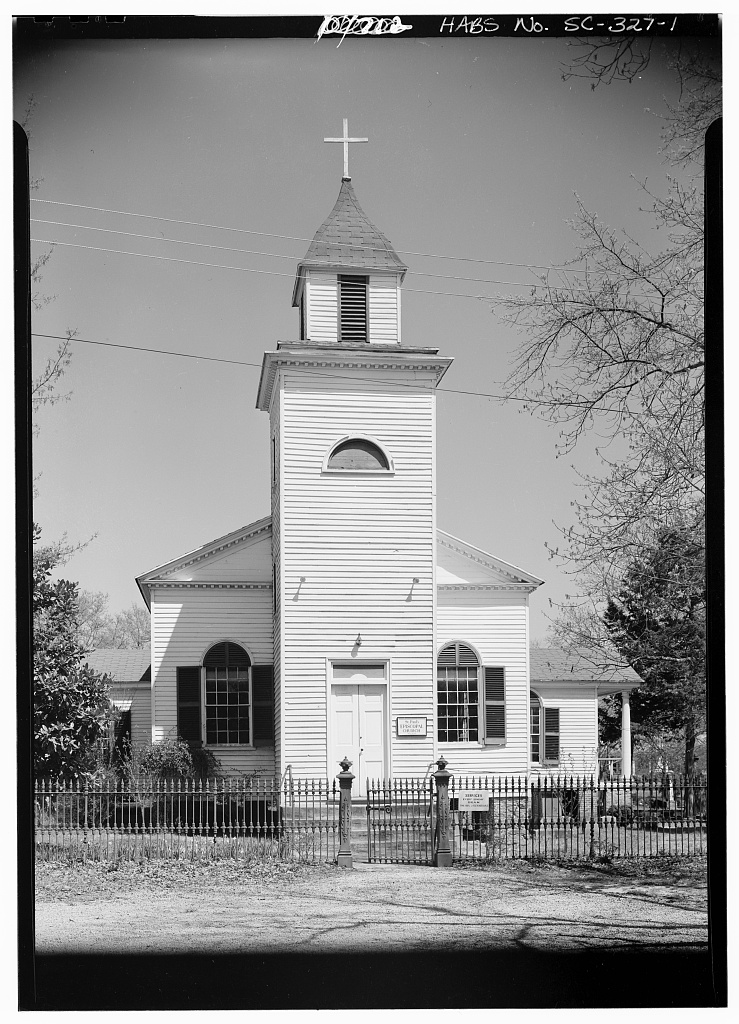
Efforts, however, had already been made toward the erection of a church. In 1820 subscriptions were taken, Bishop Bowen leading the list with $100. Mr. Benj. Dupre, Col. John E. Calhoun, and Col. James Grishaw, comprising a committee, procured a lot from the Pendleton Circulating Library for $39.00. It is somewhat surprising, in view of the stand of native timber, to note in the parish Register that the lumber for the building was hauled in ox carts from Savannah. William Henry Morningstar, reputed to be of Indian extraction, was given the contract to build. Consequently the structure (50 ft. by 32 ft.), built in the shape of a simple rectangle, was completed in 1822 and consecrated by Bishop Bowen in 1823. The bell tower added later contains a bell from the ship, Seabrook, which sailed many years ago from Charleston to Edisto Island; the original bell was given to the cause of the Confederacy during the war.
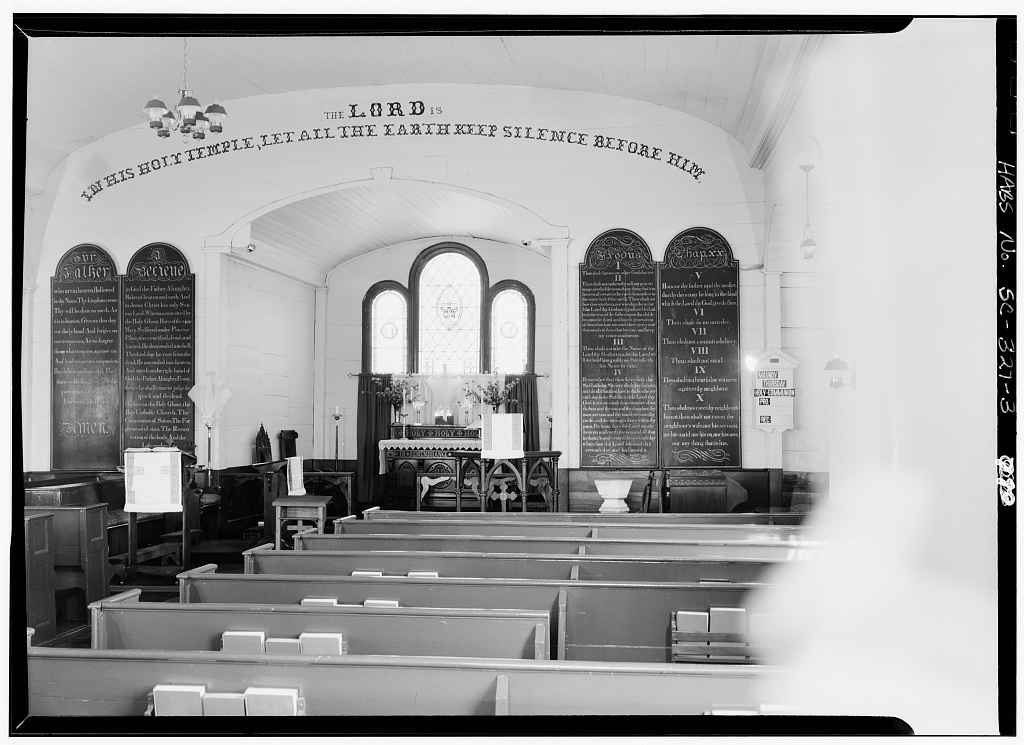
Part of the building is the winding stairway, opening off the vestibule, which leads to the balcony where the slaves worshiped. In 1829 there were only 3 pews, a paucity that may be accounted for in the By Laws of St. Paul's. Article 1 states that every pew is entitled to 1 vote, and Article 7 says that pew assessments are to be paid every six months. According to Article 3, the treasurer "shall publish all cases of vacancy on the next Sunday after such vacancy or vacancies be filled." In 1833, five pews were added as well as a vestry room. The present organ was purchased in 1848 by popular subscription ($300.00). Prior to the installation, Dr. Thomas Dart "raised the tunes." Mrs. John C. Calhoun was active in raising the funds because she complained that Dr. Dart "failed to carry the tune" and because of the "hissing sound he made." Then in 1854 a rectory was acquired at a cost of $1,100, possibly reflecting the new prosperity resulting from the building of the Blue Ridge Railroad in 1853. In 1860, the churchyard was enlarged one and one half acres by purchase and fenced in front in 1890. The most recent construction was the parish house, completed in 1955. Throughout the years numerous gifts and memorials have provided most of the furnishings and church vessels.
The clergy who have served St. Paul's since the Reverend Rodolphus Dickinson are:
- F. H. Rutledge 1831-1832
- W. H. Barnwell 1933
- Wm. T. Potter 1834-1847 - 12 pews added.
- H. Cornish 1848-1875 - In 1875 he was also holding services in Seneca and Walhalla.
- Henry T. Gregory 1875-1877
- Wm. H. Hanckel 1878-1884
- Thos. F. Gadsden 1884-1891
- Octavius T. Porcher 1891-1900 - He began services at Fort Hill and at Clemson.
- Benj. MacKenzie Anderson 1900-1901
- Kirkman G. Finlay 1902-1907 - Consecrated Bishop 1921. His dusty shoes from his 4-mile hike from Clemson were a familiar sight in St. Paul's.
- Lyttleton E. Hubbard 1909-1911
- R. M. Marshall 1912-1916
- Jas. M. Stoney 1917-1922 - He was later Bishop of New Mexico. The centennial was celebrated May 2, 1920, Bishop Guerry preaching.
- Geo. E. D. Zackery 1922-1925
- A. W. Taylor 1927
- Capers Satterlee 1928-1936
- Donald E. Veale 1936-1941
- In. A. Pinckney 1941-1948 - Consecrated Bishop 1963
- R. Emmett Gribbin, Jr. 1948-1951
- Jack W. Cole 1951-1958
- G. F. Bright 1959
- J. F. Lowe 1959-1961
- Marshall O. James 1962-1963
- John W. Arrington, I 1963-1969
- Thomas C. Davis, Jr. 1970-1995
- Frank Larasay 1996
- Gil. Dent 1996-1998
- David R. Ferner 1998-2002
- Melvin K. Gray 2003-2005
- John S. Nieman 2006-2016
- Suz Cate 2016-
Among St. Paul's faithful parishioners none have been more unstinting of constant devotion and selfless love than, in the past, W. H. D. Gaillard, who died September 11, 1890, aged 79, and Miss Louise Hunter, still remembered by many for her never failing support for St. Paul's.
CHURCHYARD
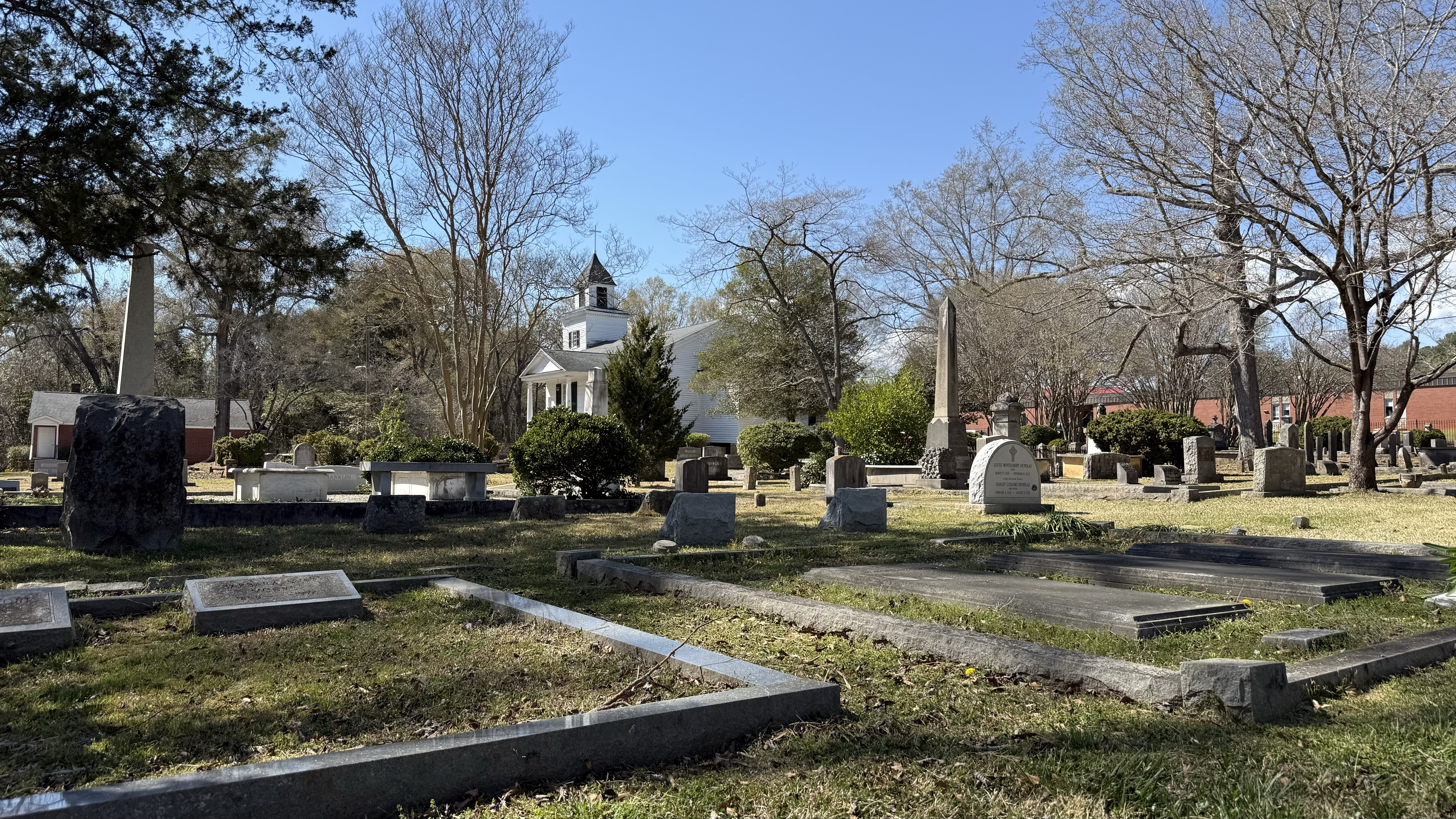
In the Churchyard lie many of the state's most celebrated men and women. Among them are:
- Mrs. John C. Calhoun, a lifelong member of St. Paul's (John C. Calhoun is buried at St. Philip's in Charleston.)
- General Barnard E. Bee, who gave the name "Stonewall" to Gen. Thomas Jonathan Jackson.
- William Henry Trescot, historian and U. S. diplomat
- The Rev. Jasper Adams, first president of Hobart College
- The Rev. Paul Earle Sloan, St. Paul's only postulant for Holy Orders
- Thomas G. Clemson and his wife, Anna Maria Calhoun